On 9 October 2026, the first whistle at Nyayo National Stadium will do more than begin another weekend of rugby. It will open the next chapter of a Kenyan sporting story that began three decades ago, when a small group of rugby enthusiasts decided that Kenya needed to see more of the world’s best sevens talent at home.
From 9 to 11 October, Nairobi will host the 30th anniversary year of Safari Sevens. The tournament may not have been staged in every calendar year since its birth, but its place in the country’s sporting memory is uninterrupted. Safari 7s is a tournament, a gathering place, a talent factory and, at its best, one of the great social occasions on the Kenyan calendar.
This is a story of ambition, hard work, music, mud, bright lights, full stands, empty seats, heartbreak and renewal. Above all, it is the story of people who believed that a Kenyan rugby weekend could become much bigger than a rugby weekend.
The origins of Safari Sevens lie in a very practical problem. In the professional era, the overseas rugby tours that had once brought leading British clubs to Kenya began to disappear. Kenya was still a passionate rugby country, but the regular opportunity to watch high-level international talent on home soil was fading.
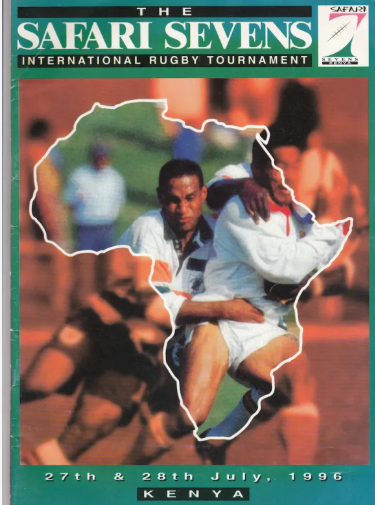
The Rugby Patrons Society, remembered in one account as a small band of rugby enthusiasts, responded with an idea that was both modest and audacious: bring representative and invitational teams to Nairobi for a sevens tournament. The Kenya Rugby Union nurtured that idea, and the first Safari Sevens was held at the RFUEA Ground in 1996.
The inaugural competition immediately announced what the tournament could become. Public School Wanderers from England won the main cup, defeating Zimbabwe 40–15. Kenya won the Plate after beating Uganda, while Cumbria took the Bowl against Shujaa, Kenya’s second-string side. The event also attracted names of international stature, including Welsh international Colin Charvis and South Africa’s 1995 Rugby World Cup winner Chester Williams, who served as chief guest.
It was an important beginning, but it was not built by one person or one institution. The early Safari Sevens depended on the imagination of rugby patrons, the administrative work of the Union and its secretariat, the goodwill of visiting teams, the commitment of officials, the energy of volunteers and the practical support of government and commercial partners. Before there were giant stadiums, polished event villages and global broadcasts, there were people making phone calls, preparing pitches, finding accommodation, moving teams and trying to make an international tournament feel at home in Nairobi.
That spirit remains central to the Safari story. The tournament grew because each generation inherited something from the one before it and then tried to add a little more.
The early years belonged to players who helped establish the character of Kenyan sevens: quick, creative, fearless and willing to play with an instinctive freedom that made the game accessible even to spectators who did not know every law of rugby.
Kenya’s first Safari title arrived in 1997 under coach Ham Onsando. The victory was emphatic with Kenya defeating Cumbria School Boys in the final. The side, led by the flamboyant Sammy Khakame, included Jeff Tolo, Felix Ochieng, Manu Okoth, Andrew Ondiek, Paul Murunga and Steve Gichuki, among others.
Those names deserve to be remembered not simply because they won a trophy, but because they gave the home crowd its first unmistakable proof that Kenyan rugby could stand at the centre of its own festival. The players who followed included Ken Aswani, Oscar Osir, Benjamin Ayimba, Humphrey Kayange, Collins Injera and many others turned Safari Sevens into a launchpad for careers that would carry Kenyan rugby far beyond the RFUEA fence.
The early tournament also showed that Kenya’s strength was not confined to one select side. In 2000, Shujaa, then Kenya’s second-string team, edged Bristol University Select 26–24 in a close final. That side featured Tony Ongoro, Arthur Indeche, Andrew “Smudge” Smith and Jeff Vilembwa. The depth represented by such teams was one of the reasons Safari Sevens mattered: it gave established internationals a stage, while giving the next generation a demanding audience and serious opposition.
Over the years, the list of Kenyan players associated with the tournament became a living roll call of the country’s sevens history. Sidney Ashioya’s last-minute try in the 2010 final remains one of the defining Safari moments. Gibson Weru’s grubber created the opening, and Ashioya reacted first as Kenya beat the Emerging Springboks 17–12 in the rain. In 2019, Geoffrey Okwach, Johnstone Olindi and Jeff Oluoch helped the Kenya Morans(the current second-string team) build a 19–0 halftime lead against South Africa before holding on for a famous 19–14 victory.
These are the kinds of memories that make a tournament live beyond its results. They are remembered in clubhouses, in school rugby conversations and in the stands by supporters who can still tell you where they were when a try was scored.
As the tournament expanded, so did its identity. For a generation of fans, it was the Tusker Safari Sevens. That title captured an era when Kenya Breweries’ support helped the event become a fixture in the social calendar as well as the rugby calendar. The tournament was not merely something to watch; it was something to plan for months in advance.
The RFUEA Ground was the spiritual home. It was close to the action, close to the players and intimate enough for supporters to feel part of the spectacle. The rugby village grew around the matches. The atmosphere developed its own language, rhythms and rituals.
Capital FM returned as official radio partner in 2018, it described the relationship as a long-standing one. Its role included publicity, interviews and live coverage. For fans, however, the partnership was felt in a more personal way: in the songs that travelled through the grounds, in the choruses that strangers sang together and in the sense that the weekend had a soundtrack of its own. One retrospective recalls strangers lining up at the village to dance to Soulja Boy’s “Crank That” in 2009, an image that says as much about Safari 7s as any scoreline.
In 2010, Safaricom entered a three-year deal to become title sponsor. The name change to Safaricom Sevens reflected a new phase of ambition. Safaricom’s support brought greater commercial weight, while the Kenya Rugby Union and its secretariat were seeking to raise standards, attract quality teams and eventually win Kenya a place on the International Rugby Board’s sevens circuit. The company’s 2010 tournament announcement spoke of a deliberate effort to showcase first-class rugby to thousands of fans and to leave a legacy through coaching clinics for schools, women’s rugby and community players.
The tournament’s reach also widened through broadcasting. SuperSport carried the 2010 proceedings live to viewers across Africa, while K24 provided terrestrial coverage for Kenyan audiences. The ambition was clear: Safari Sevens should be experienced not only by those inside the RFUEA, but by millions watching at home.
Broadcasting changed the scale of the event. So did the teams. By 2008, Fiji and Samoa had appeared, and the tournament had hosted Waisale Serevi, the Fijian master widely regarded as one of the greatest sevens players ever to play the game. Serevi appeared as a guest player for Shujaa, an extraordinary moment for Kenyan supporters and a reminder that Safari Sevens had become a place where global rugby names could meet local ambition.

The visitors were not there just to decorate the programme. British Army sides, Emerging Springboks, Samoa, Argentina, Georgia, Grenoble, Bristol, Ponsonby, Uganda, Namibia, Zimbabwe, Portugal, Spain, Japan, France, Canada and invitational teams such as Samurai helped make the tournament genuinely international. The standard of opposition gave Kenyan players a test, and the event gave visiting players a memorable introduction to Nairobi.
By 2011, RFUEA was struggling to contain the tournament it had helped create. The grounds had become packed, and the decision was taken to move to the larger Nyayo National Stadium. The reasoning was straightforward: the tournament needed more room for spectators, corporates, and growing public interest.
The move was not a rejection of RFUEA. It was an acknowledgement of what Safari Sevens had become. Nyayo offered greater capacity, improved accessibility and a venue capable of accommodating an event that now wanted to be a major sports-tourism property. The 2012 edition, held at Nyayo, was promoted as a must-attend event, with a star-studded Samurai side featuring six All Blacks and the Fijian captain. Organisers also explored bringing New Zealand great Jonah Lomu as guest of honour.
The numbers from this period are extraordinary. Former KRU chairman Mwangi Muthee recalled that queues once stretched along Lang’ata Road and that more than 30,000 fans came through the gates. Former Local Organising Committee chairman Sasha Mutai put the 2012 attendance at 45,000.
The 2013 edition was the high-water mark of Safari Sevens as both sporting event and a national festival. The tournament had moved to the Moi International Sports Centre, Kasarani, to meet demand and strengthen Kenya’s case for hosting a leg of the global sevens series. Government support, Safaricom, Kenya Airways, Coca-Cola and other partners helped create the kind of platform that could make the bid credible.
Then the Westgate attack happened.
The terrorist assault on Westgate Mall began on 21 September 2013, just a short distance from the tournament venue. It cast a shadow over Nairobi and over a weekend that was supposed to be about rugby, music and celebration. Yet the tournament did not simply disappear. The crowd came, players continued to compete, and the stadium became one of the places where Kenya’s determination was visible. Muthee recalled that 48,000 fans attended the first day despite the attack and that more than 35,000 came on the final day.
That does not make the tragedy less tragic, and sport cannot erase grief. But the response showed what Safari Sevens meant to people. In a frightening moment, the tournament became a small act of collective defiance: a decision to stand together, to mourn, keep going and refuse to let terror dictate every public space.
Every great sporting event has a difficult middle chapter. Safari Sevens has had several.
After the peak came governance disputes, changes of venue, sponsor uncertainty and a weakening connection between the product on the field and the experience in the stands. Safaricom pulled out, Kenya’s World Series bid stalled, attendance fell, and the tournament was not played in 2017. It returned in 2018 and 2019 at RFUEA, while the Covid-19 pandemic prevented the 2020 edition. The 2021 return was marked by poor attendance, and a later edition was cancelled because of a lack of sponsors.
The decline was painful precisely because the earlier success had been so vivid. Fans remembered packed grounds and spontaneous celebrations. They remembered being able to stand near the touchline and feel the speed of the game. They remembered a tournament that combined elite rugby with music, food, friends and the possibility that almost anything might happen before the final whistle.
The 2019 edition offered a glimpse of recovery. It was played at a wet, muddy RFUEA Ground, the kind of weekend when rain becomes part of the memory rather than a reason to stay away. The conditions made the rugby raw and physical, but the tournament produced one of its best modern stories when the Kenya Morans shocked a full-strength South Africa Blitzboks side 19–14. The Morans led 19–0 at halftime and then endured the South African response.

The win mattered beyond the trophy. It reminded supporters that Safari Sevens could still produce the unexpected. It reminded young players that the home tournament could be a stage on which reputations were made. And it reminded sponsors that a well-supported rugby festival could deliver something difficult to manufacture: genuine emotion.
The international connection remained strong. In the 2018 final, Samurai defeated Shujaa 21–14 before a huge RFUEA crowd. Kurt-Lee Arendse scored for Samurai, alongside Ruan Mostert and Hugo Stiels. Arendse would later become a Springbok, but Nairobi supporters saw the speed and finishing ability before his Test career had fully taken shape. That is another part of Safari’s value: it has often allowed Kenyan fans to see tomorrow’s stars while they are still becoming themselves.
Safari Sevens has also learned that its future must extend beyond one ground. The 2024 edition moved to Kenyatta Stadium in Machakos, taking the festival to a different county and giving a wider audience the chance to experience international sevens. A tournament with national ambitions must be able to travel, build local partnerships and make rugby feel present beyond Nairobi.
In 2025, Safari Sevens returned to Nyayo Stadium. That return was more than a change of venue. It was a proof of concept. The tournament showed that Kenya could once again put together a large, visible, commercially attractive rugby event in a national stadium, with the space and profile required to host the next level of competition.
The proof came quickly. In February 2026, Nyayo hosted the inaugural HSBC SVNS 2 tournament. World Rugby reported that the event sold out, with 12 teams competing in the opening round of a series that offered a route towards the HSBC SVNS World Championship.
Kenya’s captain Samuel Asati told World Rugby that the team would finally have the chance to play in front of the fans who had travelled with them around the world.
That moment should be understood as part of the Safari Sevens journey. The international tournament at Nyayo did not come from nowhere. It was made possible by years of event management, venue experience, government cooperation, commercial partnerships, broadcast relationships, player development and the insistence of fans that Kenya deserved to host big rugby.
Safari Sevens helped make Nyayo feel ready for that responsibility. The 2025 edition demonstrated that the event could return to a major stadium. The HSBC SVNS 2 weekend demonstrated that Nairobi could fill it for a global rugby property. The lesson is powerful: when the tournament is properly supported, properly marketed and built around a strong fan experience, Kenya can deliver.

The 2026 anniversary edition is therefore not only a celebration of what has been achieved. It is a test of what happens next.
For the oldest supporters, it is a chance to revisit the tournament that shaped their love of sevens. They will remember the early RFUEA weekends, the Tusker years, the songs, the rain, the first Kenyan titles and the players who seemed to glide through gaps that did not exist a second earlier. For those who came of age during the Safaricom era, it is a chance to remember the transformation: the move to Nyayo, the arrival of elite international sides, live television coverage, the growing rugby village and the hope that Kenya could join the world’s major sevens events.
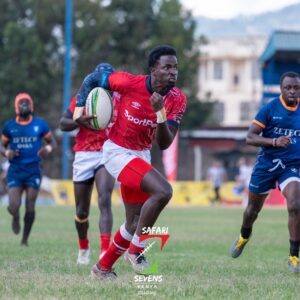
For younger fans, it is an invitation to create their own first Safari memory. They may not remember Ashioya’s try. They may not have seen Serevi play. They may only know Collins Injera, Humphrey Kayange, Benjamin Ayimba, Felix Ochieng or the current generation through clips and stories. But they can stand in Nyayo, hear the crowd rise, watch a winger race into open space and understand why sevens has such a powerful place in Kenya.
The appeal is not limited to Shujaa. The women’s game, the Kenya Lionesses, emerging sides, schools, clubs, invited teams and international visitors are all part of the tournament’s wider promise. Safari Sevens can be a place where a child sees a future, where a sponsor sees a platform, where a visiting team sees Kenya’s hospitality and where an established player rediscovers the joy of playing in front of a crowd that knows how to celebrate.
The event also needs fans to attend because atmosphere is not a detail. It is part of the product. The songs from Capital FM, the rugby village, the colours, the banter and the noise are not decorations around the rugby; they are part of why Safari Sevens became Africa’s premier sevens tournament in the first place. A full stadium gives the players energy, gives sponsors confidence and tells international teams that Nairobi is ready for them.

Safari Sevens has survived because it has never belonged only to one sponsor, one chairman, one generation of players or one venue. It has been carried by successive KRU chairs and boards, secretariats and local organising committees, referees and match officials, coaches and volunteers, government partners, broadcasters, title sponsors and the ordinary fans who bought tickets and filled the grounds.
The work of leaders such as George Kariuki, Amb. Dennis Awori, Richard Omwela, Mwangi Muthee, Oduor Gangla and Sasha Mutai belong in that wider institutional story, not as a claim that any one person created the tournament, but as a reminder that events of this scale require committed leadership at different moments. The same is true of the sponsors. Tusker helped establish the festival identity. Safaricom helped professionalize and expand the event. Capital FM helped give it a public voice and a soundtrack. SuperSport helped carry it across Africa. Other partners, including government and commercial stakeholders, helped make the infrastructure, travel, security, broadcasting and fan experience possible.
The future will demand the same collective effort. Kenya needs a stable calendar, strong commercial partners, better facilities, clear communication, quality visiting teams, serious investment in women’s rugby and youth development, and a tournament experience that respects fans. It also needs the rugby community to understand that attendance is support in its most visible form.
When fans come to Nyayo from 9 to 11 October, they will not be attending an ordinary sports fixture. They will be adding their voices to a story that began in 1996. They will be standing in the same tradition that produced Kenyan champions, welcomed Serevi, tested future Springboks, survived Westgate, endured empty years, celebrated in the mud and carried the tournament back to the national stadium.
Thirty years is long enough to prove that Safari Sevens matters. It is also short enough to remind us that the best years may still be ahead.
With the right support from fans, sponsors, government, broadcasters and the Kenya Rugby Union, Safari Sevens can become more than Africa’s premier sevens festival. It can become the launchpad for the next growth of Kenyan rugby: a dependable annual showcase, a pathway for players, a platform for women and youth, a sports-tourism asset and a bridge between local ambition and international rugby.
The invitation is simple. Come to Nyayo. Bring your friends. Sing until the players can hear you. Stay for the final. Make a memory that someone will still be telling in 2056.
Because Safari 7s has come a long way. And after everything it has survived, the most beautiful part of the journey may be that it is still moving.